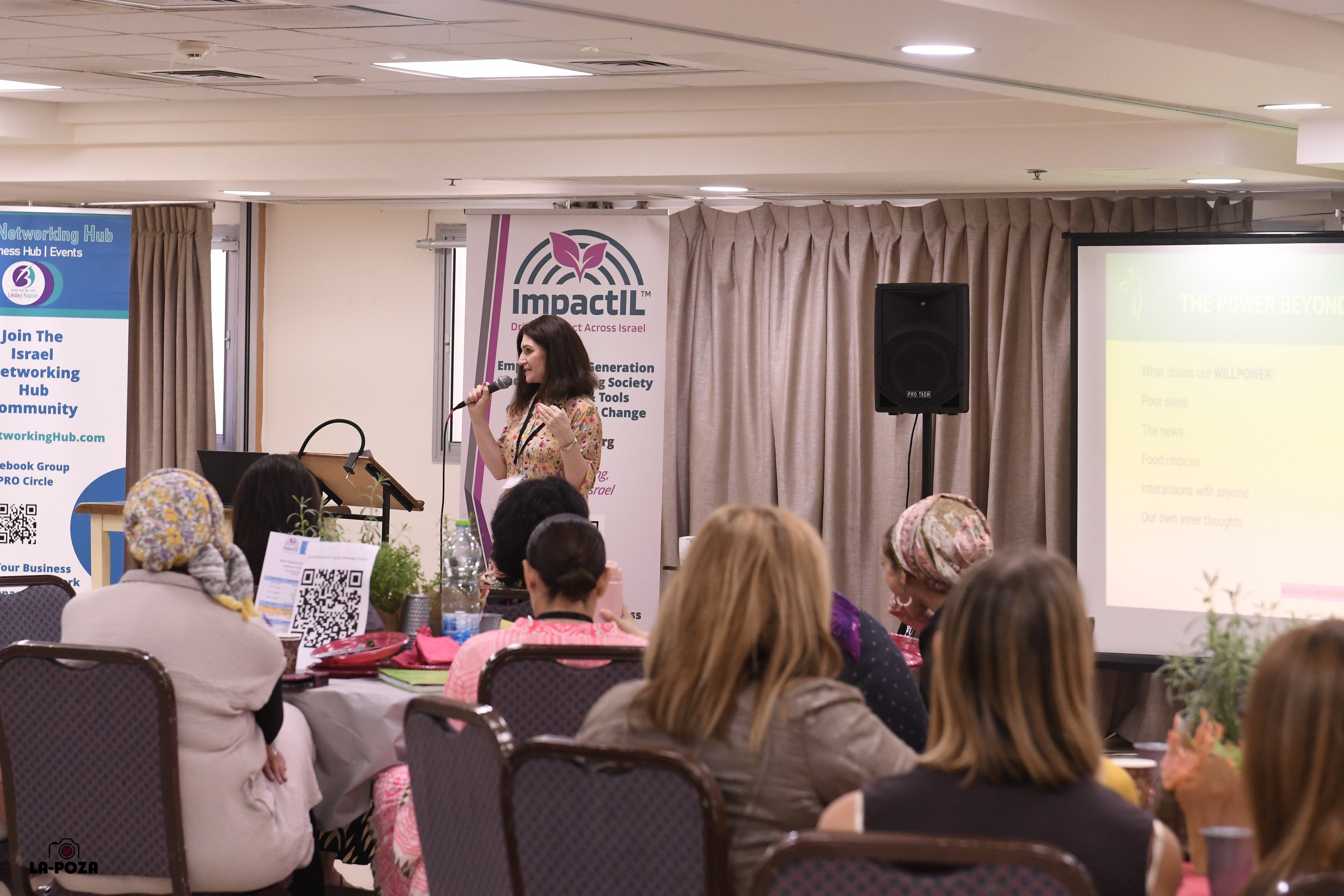
How many of you woke up this morning already tired?
I asked that question to a room full of women last week, and almost every hand went up. Then I asked another one. How many of you had a really good plan for how the day was going to go, and by three in the afternoon it had already fallen apart? The hands stayed up. And the last one: how many of you, at some point in the last week, ate something you didn't really want to eat, skipped something you meant to do, or just couldn't find the energy to care?
Me too. Every single time.
If any of that sounds familiar, I want to offer you a different explanation for it, because the one most of us have been carrying is quietly draining us.
The story we have been told
From the time we were young, we were taught that success, in health and in habits and in life, comes down to willpower. To grit. To discipline. If you are eating well and moving your body and answering every message by nine in the morning, you have it. If you are not, you are somehow weak and you need to try harder.
That story is everywhere. It is in every diet book ever written and on every motivational poster in every gym. And it is scientifically flawed.
Willpower is not a personality trait. It is not something you either have or you don't. It is a physiological state, and it is directly affected by what is happening in your body and your brain at any given moment. Think of it like the battery on your phone. It behaves like a muscle: it can be exhausted, and it can be restored. The more decisions you make, the more stress you carry, the more emotional weight you are holding, the less of it is left.
And here is the part that matters most. When your body is under ongoing stress, and for many of us right now that is simply the reality, your brain shifts into survival mode. The prefrontal cortex, the part responsible for planning and long-term thinking, goes quieter. The amygdala, your threat-detection centre, gets louder, and its whole job is to say: give me comfort, give me something that feels good right now. So you find yourself standing in front of the biscuit tin, not because you lack discipline, but because your brain is genuinely trying to look after you.
That is not weakness. That is biology. And trying to use willpower to override a survival response is a fight we were never going to win.
Being honest about my own energy
I want to share something with you, because I am living this alongside you.
My own energy is not constant at the moment. I am in perimenopause, and it has changed the way my days feel. Some days I have real clarity and focus, and other days I am running closer to empty than I would like, sometimes before I have even got out of bed. For a long time I tried to push through that the way I always had. It didn't work, and it left me more depleted.
So I have had to become genuinely intentional about where I spend my energy. I notice now which interactions fill me up and which ones drain me, and I try to protect what I have left. I pace myself. I have learned to say no to things that pull at me, even when part of me feels I should say yes, because I have come to understand that guarding my energy is not indulgent. It is how I stay able to show up well, for the women I work with, for my family, and for my own body as it moves through this change.
Taking care of yourself is not selfish. You cannot pour from an empty vessel, and the people who depend on you need you nourished and grounded enough to be present. Not perfect. Just okay.
Three tools that actually work
So if willpower is not the answer, what is? Here are three things you can use straight away. Not a twelve-week overhaul. Three real tools that work with your biology instead of against it.
1. Stabilise your blood sugar, starting with breakfast
The single most powerful thing you can do to support your energy, your mood, and your food choices is to keep your blood sugar steady through the day. And the simplest place to begin is protein at breakfast.
Not a piece of toast. Not a coffee on its own. Something with substance: eggs, yoghurt, labneh, smoked salmon, cottage cheese, a handful of nuts. When you start your day with protein, you steady your blood glucose for the hours that follow. Your brain gets a reliable supply of fuel, your cravings soften, and your decision-making improves. You feel more like yourself. This is not a diet. It is a support system for your body.
2. Give your nervous system a signal of safety
Your nervous system is constantly scanning for one thing: are we safe or not? And you can answer it, not with logic but with the body.
Your vagus nerve, the internal calming system, responds to a slow, extended exhale. When you breathe out for longer than you breathe in, you switch on the part of your nervous system that says, we are safe, you can come down now. Breathe in for four, out for six. A few rounds before a decision, before you open the fridge, before you reply to a message that has your stomach in knots, can genuinely shift your state.
Your nervous system doesn't need a holiday. It needs small, frequent moments of steadiness, and you can create them anywhere. On some busy days I leave my phone inside, sit on my balcony, close my eyes and simply breathe for a minute before going back in. That is the whole tool.
3. Replace self-blame with curiosity
This one is a mindset shift, and in some ways it is the most important of the three.
When you find yourself doing something you didn't intend to do, eating when you weren't hungry, staying up too late, skipping the walk, notice the first voice that shows up. For most of us it is: what is wrong with me. Try swapping it for a gentler, more useful question: what was going on for me in that moment? Were you tired, stressed, running on empty, lonely, overwhelmed?
Behaviour never comes from nowhere. It always makes sense in context. And when you understand what is driving it, without shame and without judgement, you can actually do something about it. Curiosity is not letting yourself off the hook. It is giving yourself the information you need to do things differently next time. This is what I mean when I say work with your body, not against it. Your body is not your enemy. It is trying to tell you something, and the work is learning to listen.
The reframe I want to leave you with
The reason you have struggled is not because you don't care enough. It is not because you are lazy or undisciplined or somehow not built for consistency. It is because you have been trying to override your biology with sheer force, in one of the most demanding seasons many of us have ever lived through. That was never going to work, and not because of you.
The power beyond willpower is not some hidden reserve of strength you are missing. It is understanding. It is working with your body instead of fighting it. It is making small, sustainable choices that don't ask you to become a different person, just a slightly better-informed version of the one you already are.
So here is your one thing. Not three. Just one.
Tomorrow morning, before you open your phone, before you check the news, before you do anything for anyone else, eat something with protein in it. Two eggs. Some cottage cheese. A spoonful of nut butter with an apple. Something real. That small act is not only nutrition. It is a signal to your body that says, I see you, I am going to take care of you today. It is you putting yourself on your own list.
And from that grounded, nourished, slightly steadier place, everything else becomes a little more possible.
If this resonated, and you are tired of trying harder and feeling like your body has become a stranger to you, this is exactly the work I do with women in midlife. We start by understanding what your body is actually asking for, and we build from there, one sustainable step at a time.
I offer a short, no-pressure clarity call to see whether we are a good fit and to help you find your first meaningful step.
Book your clarity call here